Thinking about Kitchens. Beyond Margarete Schütte-Lihotzky
Conference on the Occasion of the 100th Anniversary of the Frankfurt Kitchen
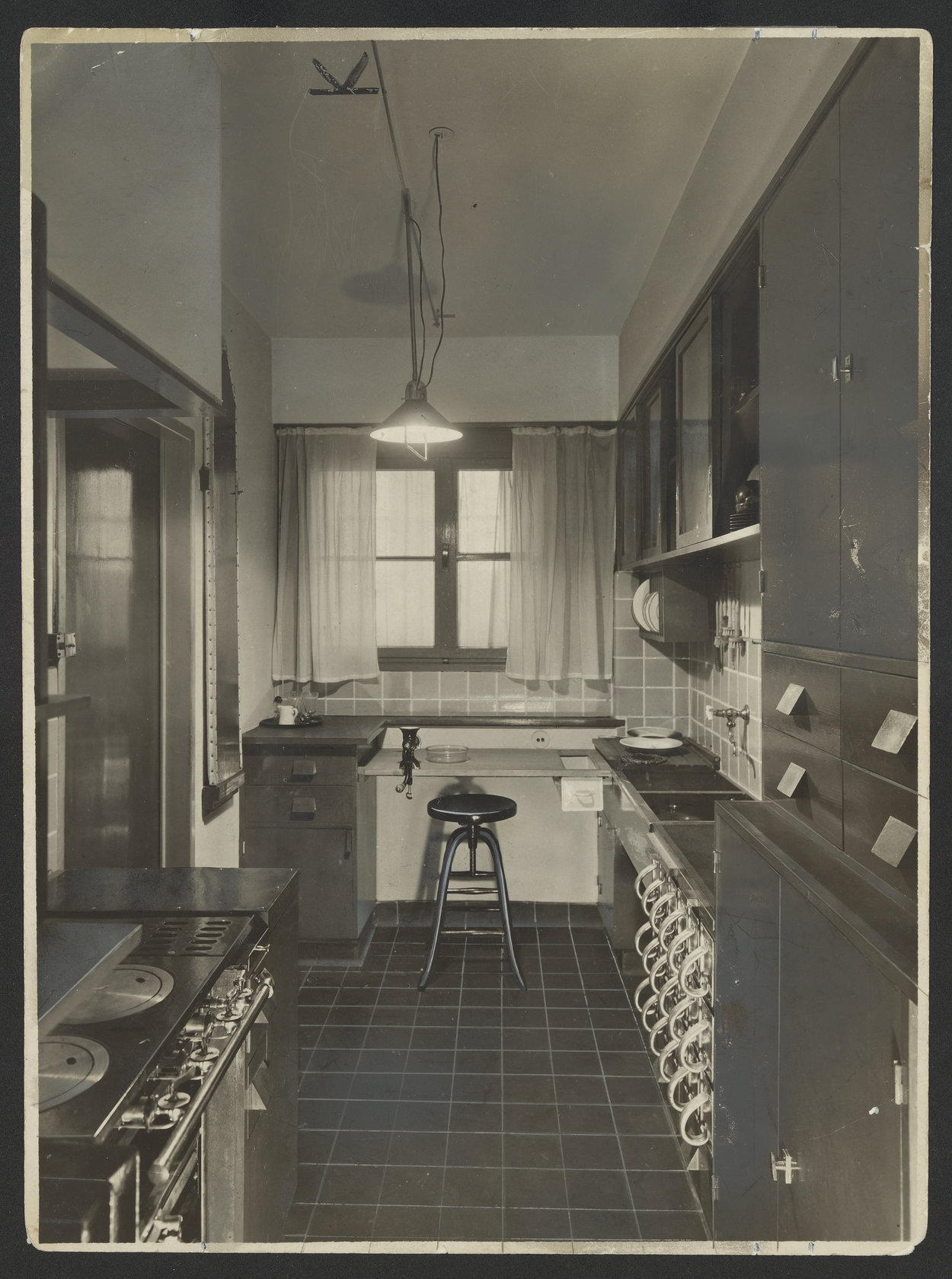
Margarete Schütte-Lihotzky, Ausstellungsmodell "Frankfurter Küche", 1927
Kunstsammlung und Archiv, Universität für angewandte Kunst Wien / Bildrecht GmbH, Foto: Hermann Traugott Collischonn
Info
- Location
University of Applied Arts Vienna
Auditorium, Vordere Zollamtsstraße 7, 1030 Vienna- Organized by
Stefanie Kitzberger and Bernadette Reinhold (Collection and Archive, University of Applied Arts Vienna) in cooperation with Judith Agostinovic, Christine Oertel, and Christine Zwingl (Margarete Schütte-Lihotzky Center, Vienna)
- With contributions by
Renate Allmayer-Beck, Bettina Buchendorfer, Eva Engelbert, Ljubica Jakšić, Maria Shéhérazade Giudici, Ruth Hanisch, Waltraud P. Indrist, Juliet Kinchin, Stefanie Kitzberger, Mary McLeod, Mara Sánchez Llorens, Christine Oertel, Monika Platzer, Brigitte Podgorschek PRINZpod, Anna Puigjaner, Bernadette Reinhold, Barbara Reisinger, Christina Schraml, Anna Stuhlpfarrer, Roswitha Väth, Marie-Noëlle Yazdanpanah, Jenni Tischer and Christine Zwingl
- Keynote
Mary McLeod, Columbia GSAPP
Designed in 1926 by Margarete Schütte-Lihotzky (1897–2000), the Frankfurt Kitchen is now firmly established in the canon of architectural and design history. Its centennial offers an opportunity to revisit the kitchen—not only as an architectural and historical design model but also as a social, political, and economic space.
As a space where architectural innovation and the gendered division of labor become entangled, the kitchen becomes a lens through which we can critically rethink architectural typology: How does the kitchen shape social relations and reproductive labor within capitalist economies? What emancipatory potential might architectural design offer in this context?
The conference addresses these questions by examining the position of the Frankfurt Kitchen in twentieth-century architectural history and considering it as a nexus of transnational discourses on the relationship between labor, gender, economy, technology, and social reproduction. It considers Schütte-Lihotzky’s kitchen designs in relation to both contemporaneous and later positions, tracing a trajectory from alternative models of collectivization, through a critical examination of the transformation of the Frankfurt Kitchen and other iconic designs of international modernism into museum objects, to the logics of the kitchen as a design object, caught between status symbol and standardized mass production.
The papers and discussions will be held in German and English. Translation tools will be available on site. The conference will be recorded.

